I was appointed Western Pennsylvania Section Traffic Manager on December 1, 2025. My primary responsibility is to collect net activity, station activity, and Public Service Honor Roll reports, compile them, and submit them to the Section Manager and the ARRL.
Another responsibility is to make information on traffic handling readily available and to provide training handouts and supplies for current traffic managers. To help facilitate this, I have established a web page containing relevant information and resources. The URL is :
I am also to cooperate and coordinate with the Section Emergency Coordinator so that traffic nets and emergency nets in the section present a unified public service front.
Amateur radio operators (also known as hams) are ready to provide valuable communications when all other conventional methods fail. Many amateurs have joined the National Traffic System (NTS) network, and spend their free time relaying messages, called Radiograms, completely free of charge.
You can send a message of 25 words or less, as long as it’s not business-related, urgent, or private. The NTS is an open system. Your message will be picked up by an amateur radio operator and then relayed by voice, digital modes, or even by Morse code. Finally, the recipient will get a phone call from a local ham, or the message might be delivered by mail, or in person.
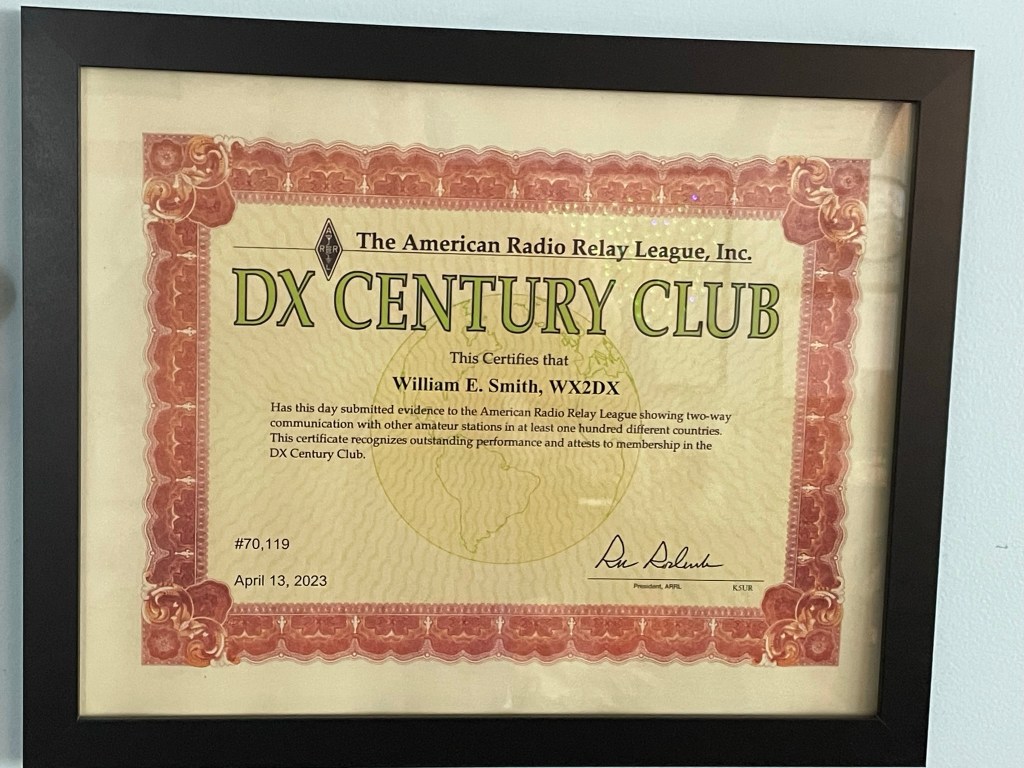
Today, I became a member of The DX Century Club (DX is shorthand for distance). I have confirmed contacts with amateur radio stations in 100 distinct geographic and political entities in the official DXCC List. It took me a little over a year to make all of the needed contacts, gleaned from over 1660 total confirmed contacts.
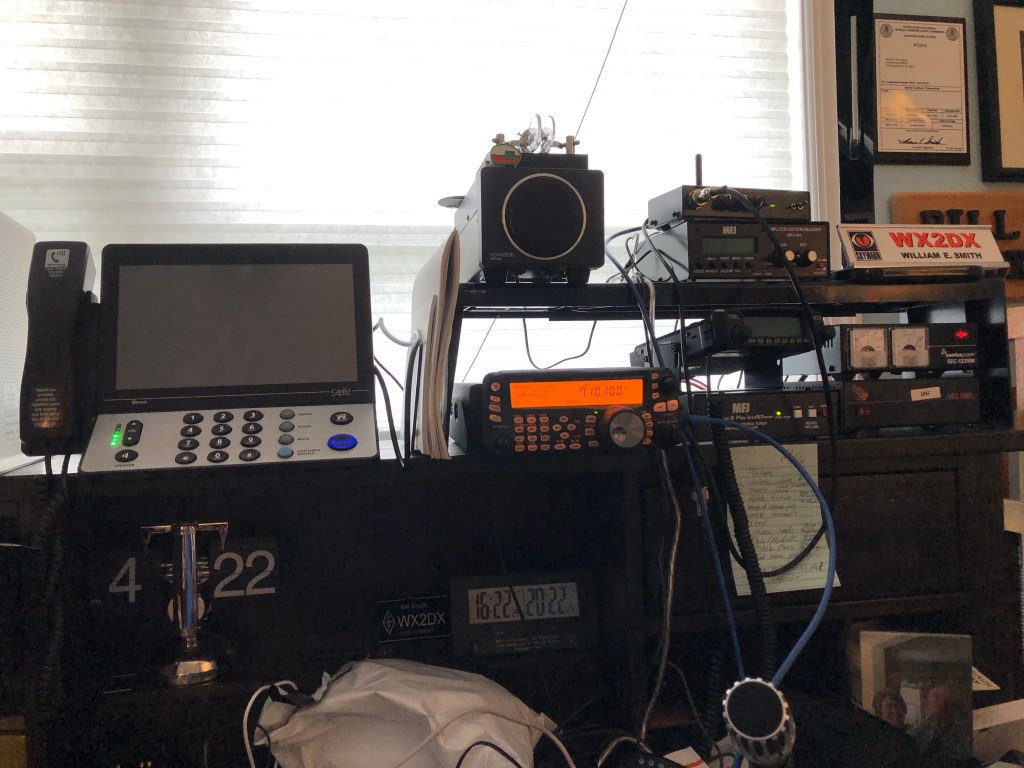
All of the following contacts were made using the FT8 digital mode, with no more than 100 Watts. My antenna is a G5RV, a simple dipole antenna with 30 feet of ladder line, and a 6-inch diameter “ugly” balun with 10 turns of the feed line. The antenna and transceiver are pictured below:
This demonstrates that big towers, antennas, and high power are not needed to work the world.
My First 100 Confirmed Countries for DXCC
Alaska
China
Ghana
Luxembourg
St. Lucia
Albania
Columbia
Greece
Madeira Islands
St. Vincent
Andorra
Costa Rica
Guadeloupe
Malta
San Andres Island
Anguilla
Cuba
Guatemala
Mauritania
Sardinia
Argentina
Croatia
Guernsey
Mexico
Scotland
Asiatic Russia
Curacao
Hawaii
Monaco
Serbia
Australia
Cyprus
Hungary
Morocco
Slovak Republic
Austria
Czech Republic
Iceland
Nambia
Slovenia
Azores
Denmark
Indonesia
Netherlands
Spain
Balearic Islands
Dominica
Ireland
New Caledonia
Sweden
Barbados
Dominican Republic
Israel
New Zealand
Switzerland
Belarus
Ecuador
Italy
Northern Ireland
Trinidad and Tobago
Belgium
El Salvador
Japan
Norway
Turkey
Belize
England
Jersey
Panama
Ukraine
Bosnia-Herzegovina
Estonia
Kazakhstan
Poland
United Arab Emirates
Brazil
European Russia
Kenya
Portugal
United States
Bulgaria
Federal Republic of Germany
Kuwait
Puerto Rico
Uruguay
Canada
Fiji Islands
Latvia
Republic of South Africa
Virgin Islands
Canary Islands
Finland
Lebanon
Rodriguez Island
Venezuela
Chile
France
Lithuania
Romania
Wales
Confirmed QSOs
I will continue to make more contacts to achieve the many endorsements (e.g. 100 entities on a single band). I already have 75 contacts just on the 40-meter band.
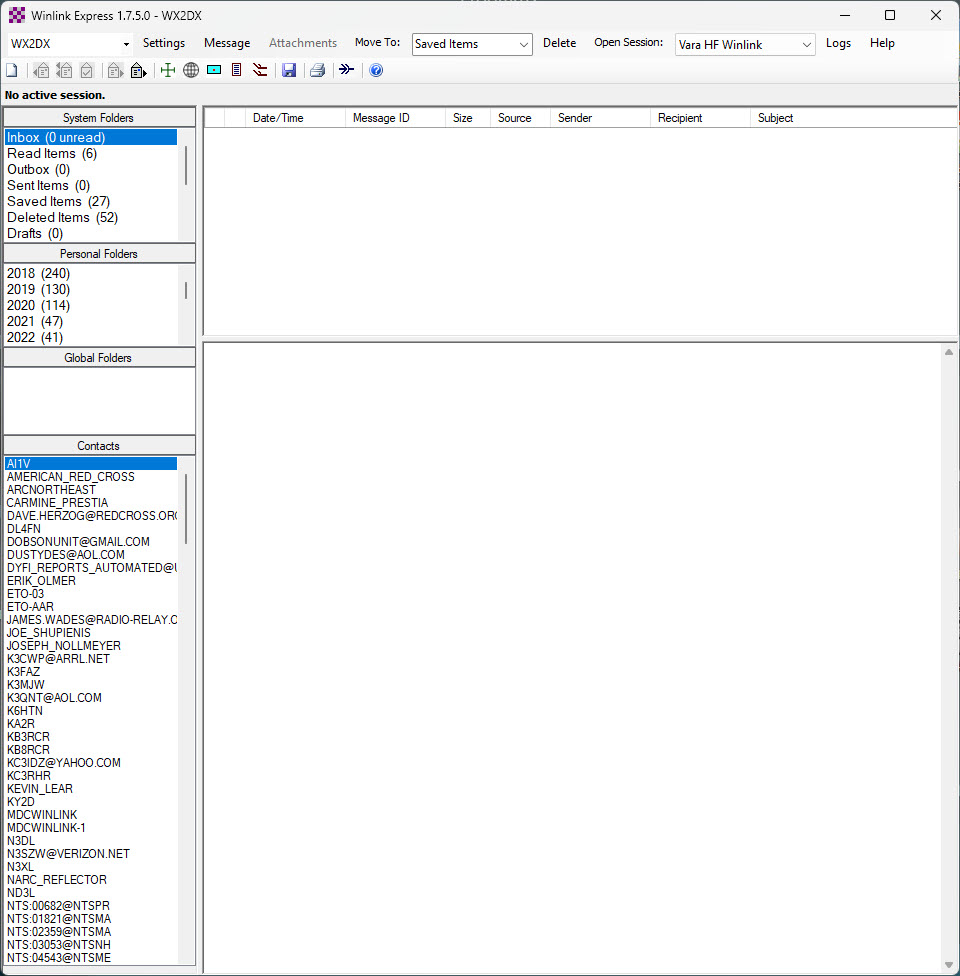
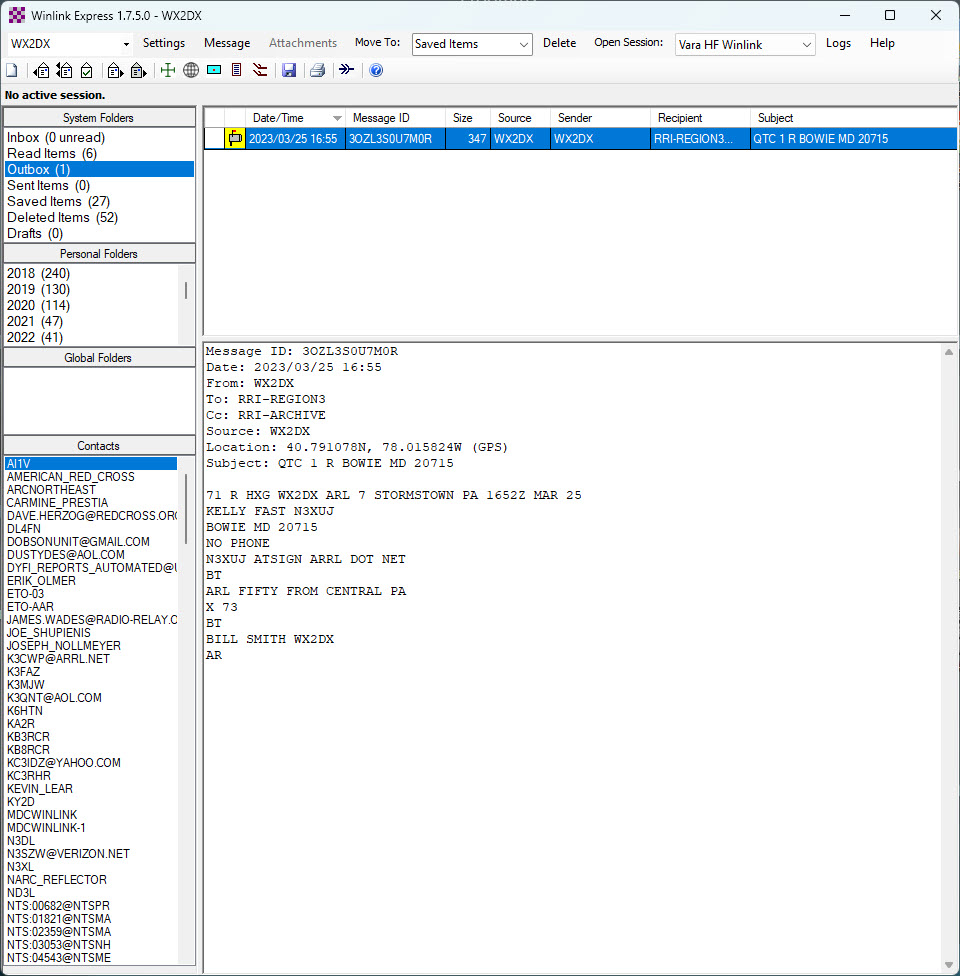
WinLink is a powerful software tool for sending and receiving digital messages via amateur radio. This post shows how a National Traffic System radiogram is sent. Belowis the main WinLink software user interface. The “Message” tab at the top of the main page is selected and the “New Message…” command is selected to create a message.
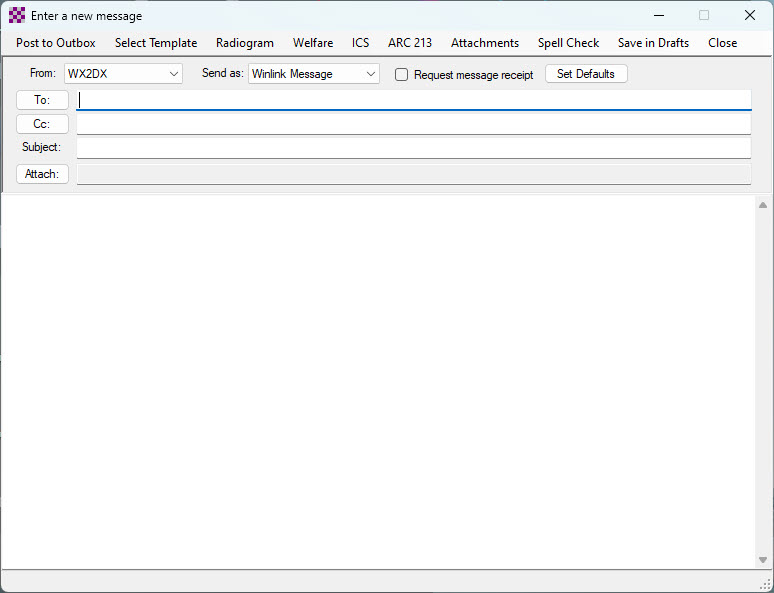
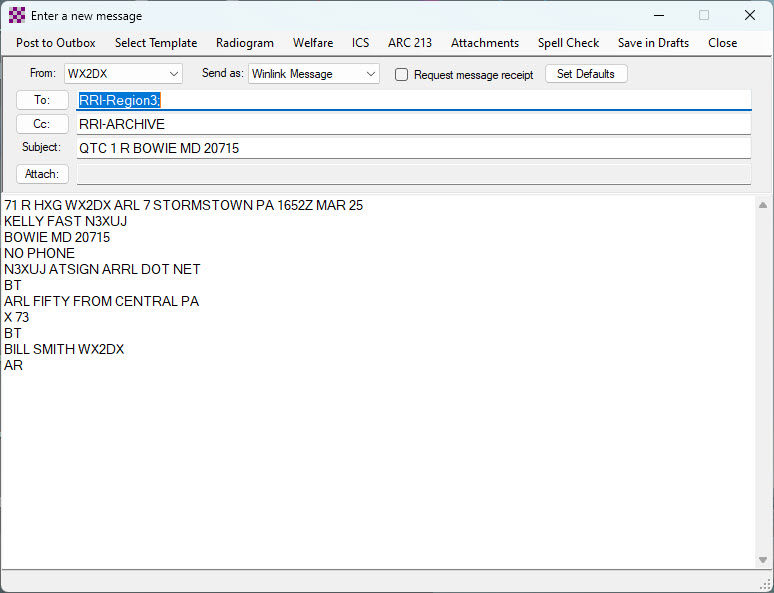
The “Enter a new message” window appears. The message needs to be entered, addressed, and formatted to send a radiogram. To proceed, select the “Radiogram” tab. I have previously setup the tab since I frequently use that template. Otherwise, use the “Select Template” tab to find the Radiogram.txt template from the many other message templates.
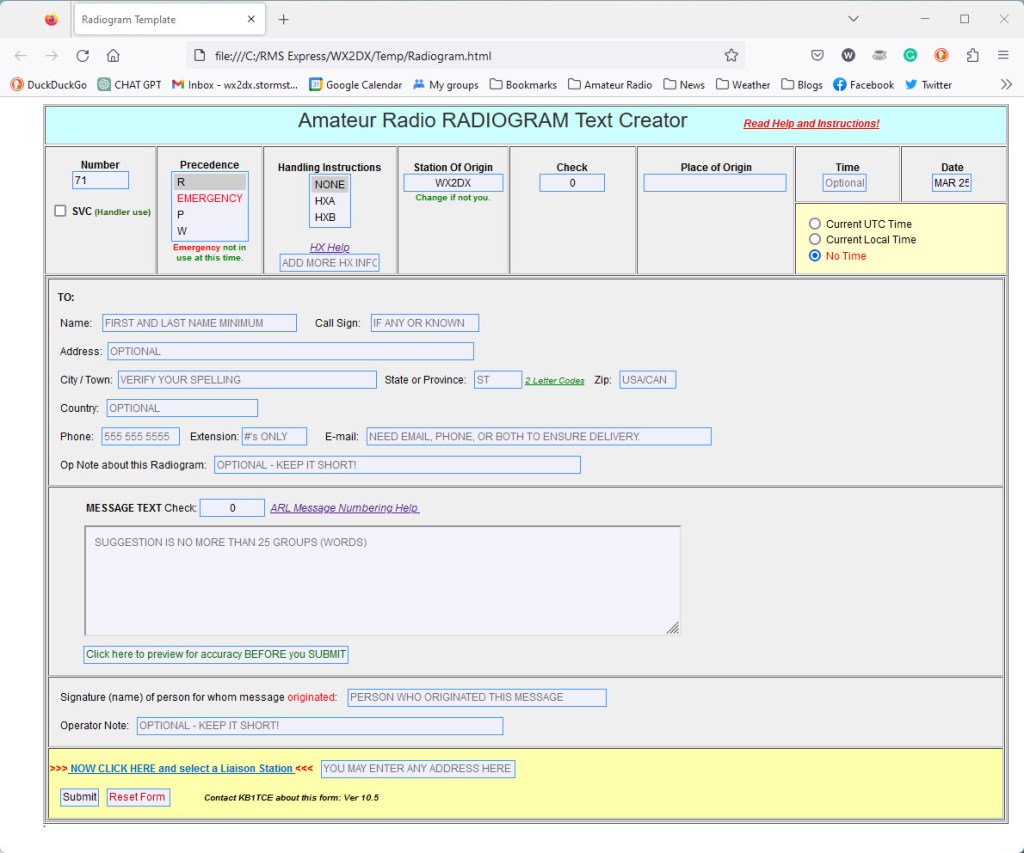
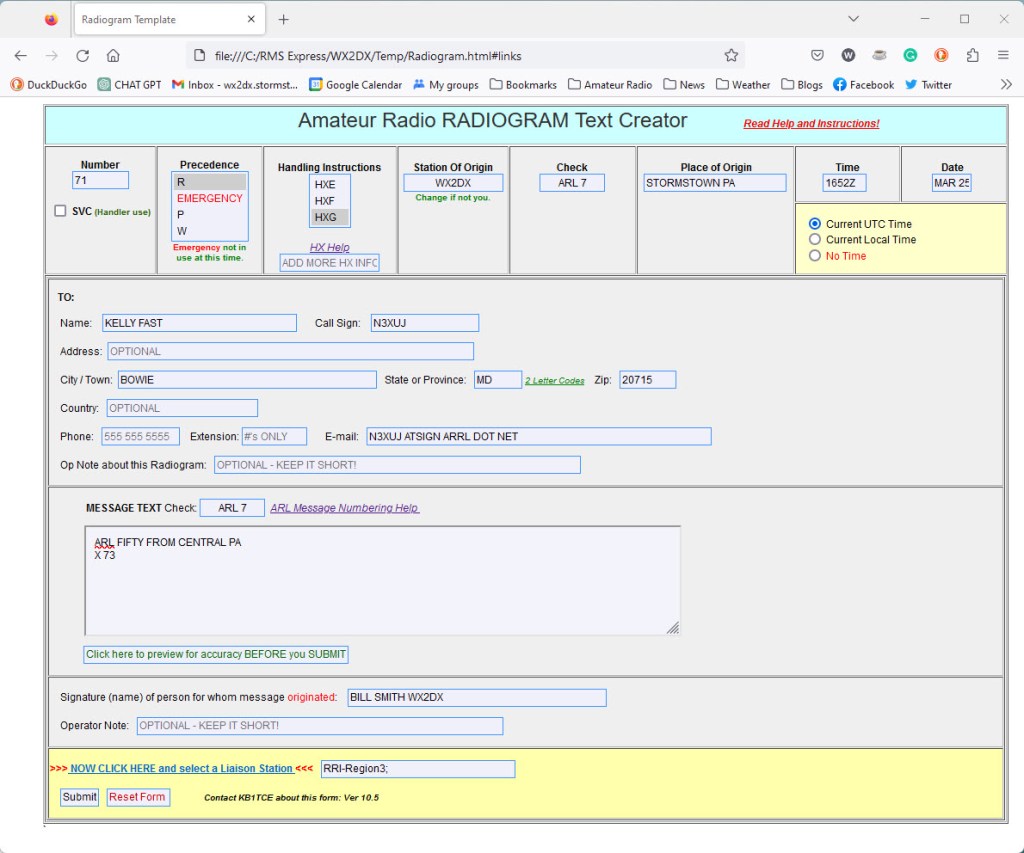
In either case, the Radiogram template is brought up in your default web browser. The message number, call sign, date, and other defaults are already filled. The information for the addressee, message, signature, and liaison station is now entered.
Here the radiogram is ready for submission. The ARL designation in the body of the message is for one of the pre formatted numbered messages. In this case it’s for the “Greetings by amateur radio” message. The ‘X’ is a period and ‘73’ means “Best Regards.”
After the “Submit” button is clicked, the “Enter a new message” WinLink window now has the “To”, “Cc”, “Subject”, and formatted NTS radiogram message boxes filled.
When the radiogram is satisfactorily formatted, click on the “Post to Outbox” tab. The radiogram is now in the “Outbox” system folder in the main WinLink window. To send the message, verify that “Vara HF Winlink” is selected from the “Open Session” dropdown menu. Then click on the “Open Session” tab.
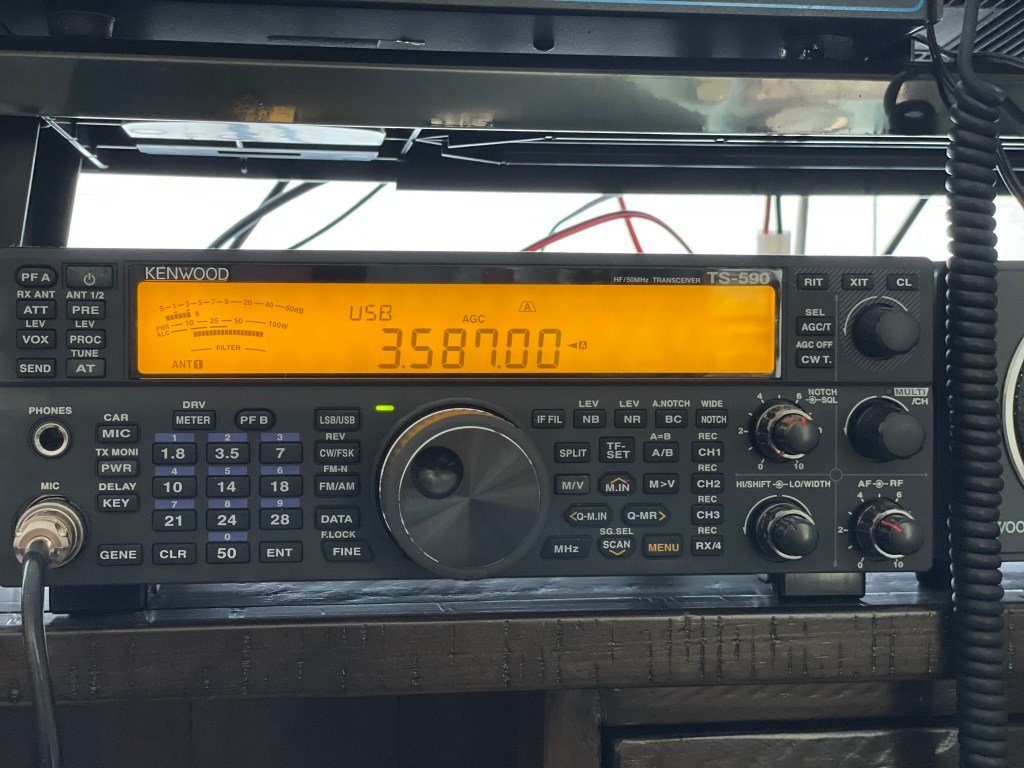
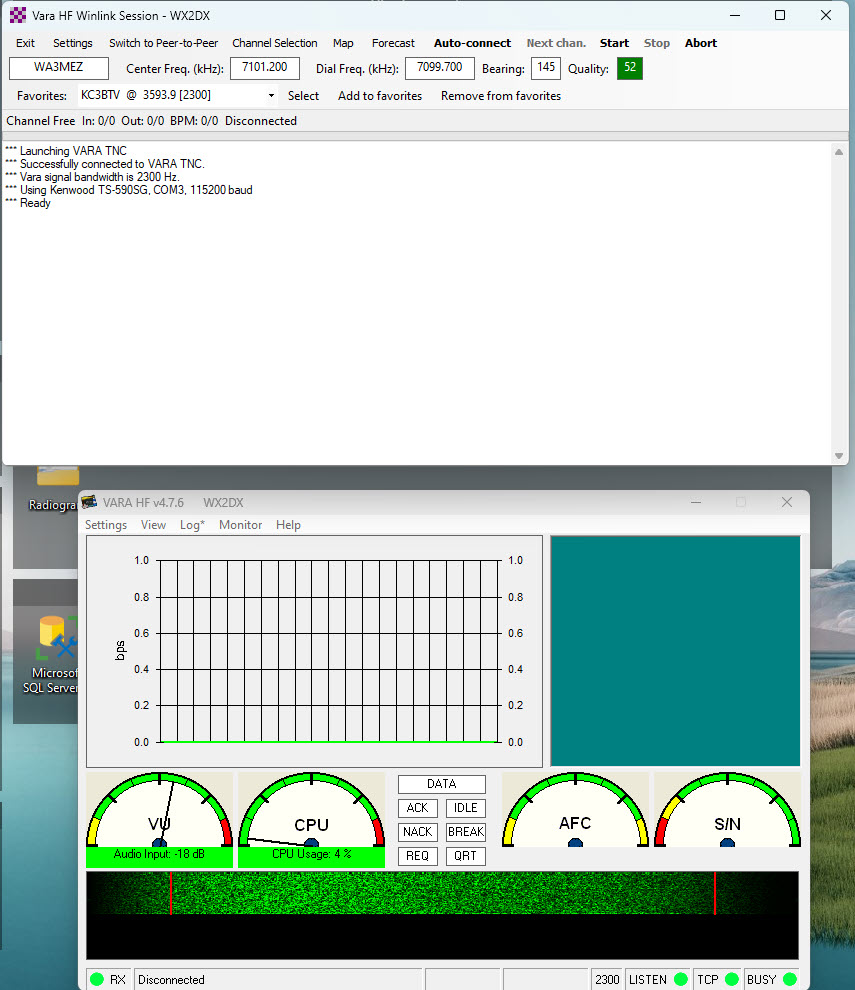
The “Vara HF Winlink Session”, and “Vara HF” modem windows are opened. Therese is the interface for the HF radio that is connected to the PC via a USB cable.
Click on the “Auto-connect” tab to set the frequency and begin transmitting. The software will cycle through the list of server stations until a connection is made. Then the message is sent, and any outstanding incoming messages are received.
Field Day has come and gone and I feel like I have had my best Field Day ever.
I made 80 unverified FT8 digital contacts with stations around The United States and Canada. Each of those contacts counts for 2 points for a total of 160 points. A 2x power multiplier makes that 320 points. I sent 59 and received 48 NTS formatted messages. Ten of those messages originated at my station and counted 10 points each. I also sent one to The Western Pennsylvania Section Manager which counted for 100 points during The Western Pennsylvania Phone Traffic Net. There are also 100 bonus points for submitting this post.
I have submitted my entry with a possible score of 670 points, which will be added to the results for my local radio club, The Nittany Amateur Radio Club.
The Western PA (WPA) Section Spring Simulated Emergency Test (SET) was held this morning from 9 AM until 12:30 PM EDT (1300-1630 UTC). I was an active participant serving as an official relay station.
The purpose of the SET was to find out the strengths and weaknesses in providing emergency communications. It also provided a public demonstration of the value to the public that amateur radio provides, particularly in time of need. It also helped radio amateurs to gain experience in communications using standard procedures and a variety of modes under simulated emergency conditions.
The emergency test scenario was as follows: freezing rain and dense fog made for hazardous road conditions. A train hit a tractor trader containing hazardous materials of unknown composition and several rail cars derailed. Local utilities were affected and power lines were arcing in the area. People are also experiencing eye and throat irritation. National Weather Service Skywarn and American Red Cross were activated.
The amateur radio propagation today was generally poor. However, radio messages were successfully handled. I was asked to monitor the 60-meter band but there was nothing but noise. I regularly checked into the WinLink digital stations WIAW and W6IDS. The latter had a significantly better signal on the 40-meter band. I also checked in with a local 2-meter station to pass messages (traffic), and into a voice net on the 75-meter band.
At end of the exercise, I had originated one message, sent 3, received 2, and delivered 1 for a total of 7 messages handled.
This week, my amateur radio station became an official digital traffic network (DTN) station. The main operating digital mode is PACTOR, an evolution of both AMTOR and packet radio. PACTOR uses a combination of simple phase shift keying (FSK) modulation, and the ARQ protocol for robust error detection and data throughput. PACTOR is most commonly used on frequencies between 1 MHz and 30 MHz.
I first looked into PACTOR last fall. I abandoned the idea when I learned that the terminal node controllers (TNCs) cost hundreds of dollars, an investment I was not comfortable making at the time. In December, I asked around about becoming a DTN station operator. I was told that the operational mode was PACTOR and I balked about having to obtain the necessary TNC. Then I was told that a used TNC would be provided. All I had to pay was a $15 dollar shipping charge. That was more than acceptable. Soon, the loaner TNC arrived. It was about 25 years old and supposedly could handle the required PACTOR digital node.
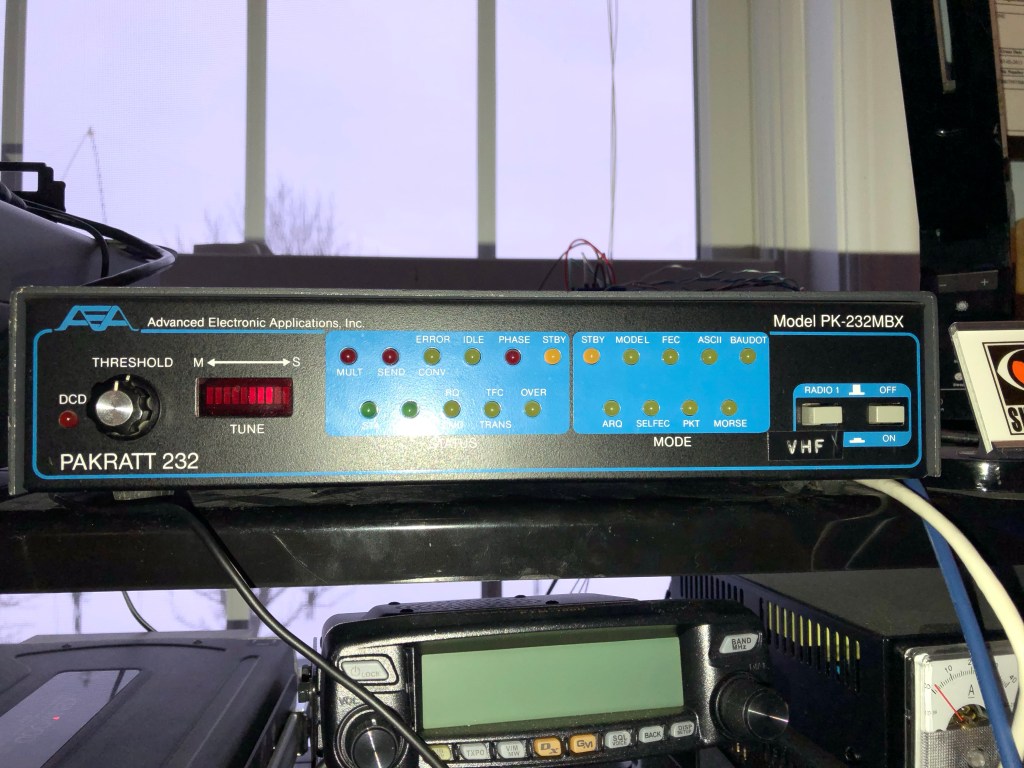
Advanced Electronic Applications, Inc. PK-232MBX TNC
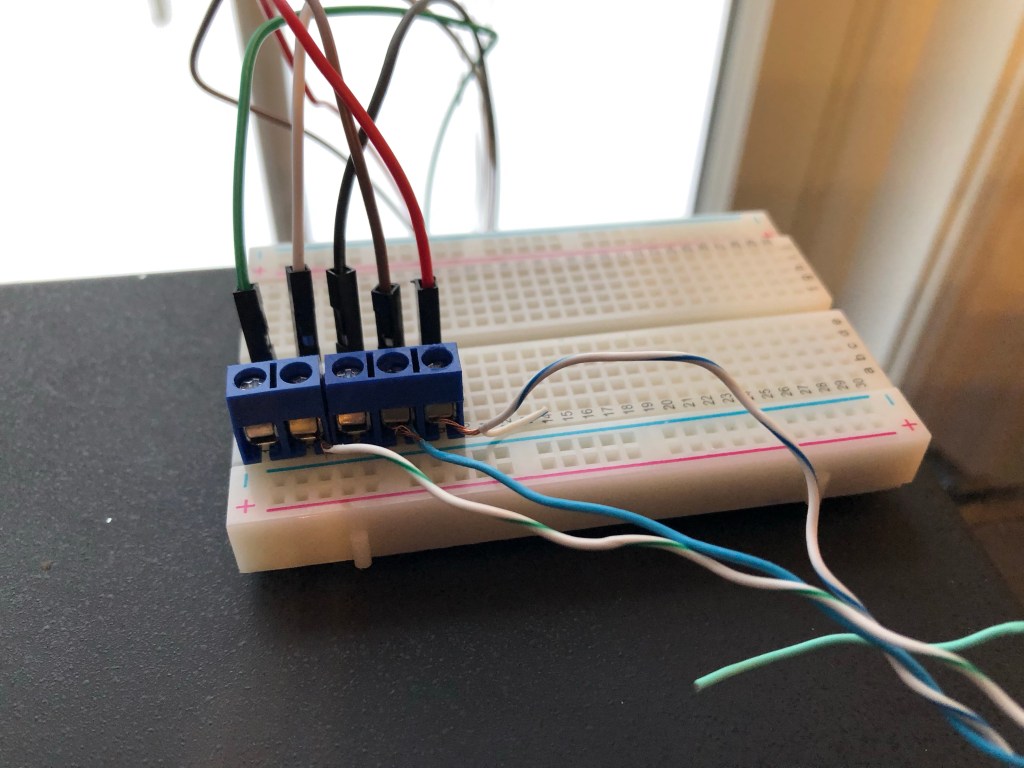
I found a appropriate AC/DC adapter, but I had to jury-rig a mic cable to connect it to my radio and the 5 pins on the back of the TNC. I also had a audio cable on hand for the radio output to the TNC. An RS-232/serial port USB adapter cable connects the TNC to my laptop PC.
Breadboard for connecting a CAT6 twisted-pair cable to the TNC
The AirMail software was downloaded and installed on my laptop. That needed to be configured to interface with the TNC. The TNC was switched on and AirMail was opened. Following initialization of the HF mode, the TNC successfully initialized. My radio AGC was set to 6 and for 40 watts output. It was then tuned to a frequency for a nearby PACTOR station. Then the receive threshold was properly set on the TNC. I tried to connect to a PACTOR station but no joy.
After several days of troubleshooting, with the assistance of two fellow amateur radio operators, I tried a loopback test on the TNC. This involved disconnecting the TNC from the radio and connecting the mic and audio input pins, on the TNC, with a jumper wire. Then a terminal software app was setup to connect the TNC with itself. This test failed and indicated the problem was with the TNC.
I was able to obtain an identical TNC on eBay for a modest and very affordable price. When it arrived, I quickly set it up for a loopback test. The test was successful. I then connected it to my laptop and radio, and it successfully connected to a PACTOR station. The operators of two PACTOR stations modified their configurations to recognize my station. Then I was able to send and retrieve national traffic system (NTS) messages.
I now routinely log in to retrieve NTS messages from The 3rd Region Hub for The Western Pennsylvania Section, on every even numbered day, sharing the responsibility with another amateur radio operator who checks in on odd numbered days. After retrieving messages, I relay them via The Western Pennsylvania Phone Traffic Net, or deliver them via phone, email or US Mail. I also originate my own messages to send via the NTS.
Contact me if you wish to originate an NTS message.
The American Radio Relay League (ARRL) Field Day is the most popular on-the-air event held each year, on the fourth weekend in June, in The United States and Canada. More than 40000 radio amateurs gather to operate from remote locations. It is a time where many aspects of amateur radio come together to highlight its many roles. It is an excellent opportunity to demonstrate its emergency capabilities to organizations and the general public. Despite the development of modern communications systems, they can fail. When they do, amateur radio can provide communications support during emergencies and post-disaster situations.
This year was different due to the COVID-19 restrictions. Instead of gathering and setting up at public locations, amateur radio operators (hams) were encouraged to operate from home. In addition, one rule was waived to allow those operating on commercial power to contact other stations that were also operating on commercial power. All other rules applied. Some hams operated on power provided by batteries, generators, solar panels, or other means not using commercial power.
Hams across North America communicated using voice, morse code (carrier wave or CW), and many digital modes. They operated to make as many contacts as possible from 2 PM EDT on Saturday until 2 PM EDT on Sunday. According to the rules, those that waited until 2 PM Saturday to set up their stations were permitted to operate until 8 PM on Sunday.
As for myself, I made 28 contacts on the 20 and 40-meter bands using the digital phase shift keying 31 baud mode (PSK31). Each contact sent digitally is worth 2 points each. Since I used only 50 watts of power, I qualified for a multiplier of 2, so my score was 112 points. I also sent 10 formal radiograms (100 points), including one to the ARRL Western Pennsylvania Section Manager (another 100 points). Finally, I submitted my Field Day entry electronically (another 50 points). My preliminary total was 462 points. I made contacts in Alabama, Florida, Illinois, Indiana, Iowa, Maine, Massachusetts, Michigan, Minnesota, Missouri, New Jersey, New York, North Carolina, Pennsylvania, Tennessee, Wisconsin, and Ontario.
Today was the 2020 Spring Simulated Emergency Test (SET) amateur radio network in western Pennsylvania. The SET is a training exercise involving the Amateur Radio Emergency Service (ARES) and the National Traffic System (NTS), a message-handling service of amateur radio. Its primary purposes are to evaluate strengths and weaknesses in emergency preparedness and communications and to demonstrate amateur radio to the public.
My simulated position was at The Grays Woods Elementary School Emergency Shelter. However, I was actually operating from my home VHF/UHF and HF base stations. We were all sheltering in place due to the COVID-19 pandemic. I was mainly operating on 75 meters using the Olivia digital mode.
We were sending formal formatted messages to net control. I sent three pieces of traffic containing shelter status. However, it got a bit silly at the end of the exercise. There was a message announcing the touch down of a tornado west of Pine Grove Mills in The PSU Ag fields. Then there was a voice message concerning a hungry elephant found in a closet at Juniper Village.
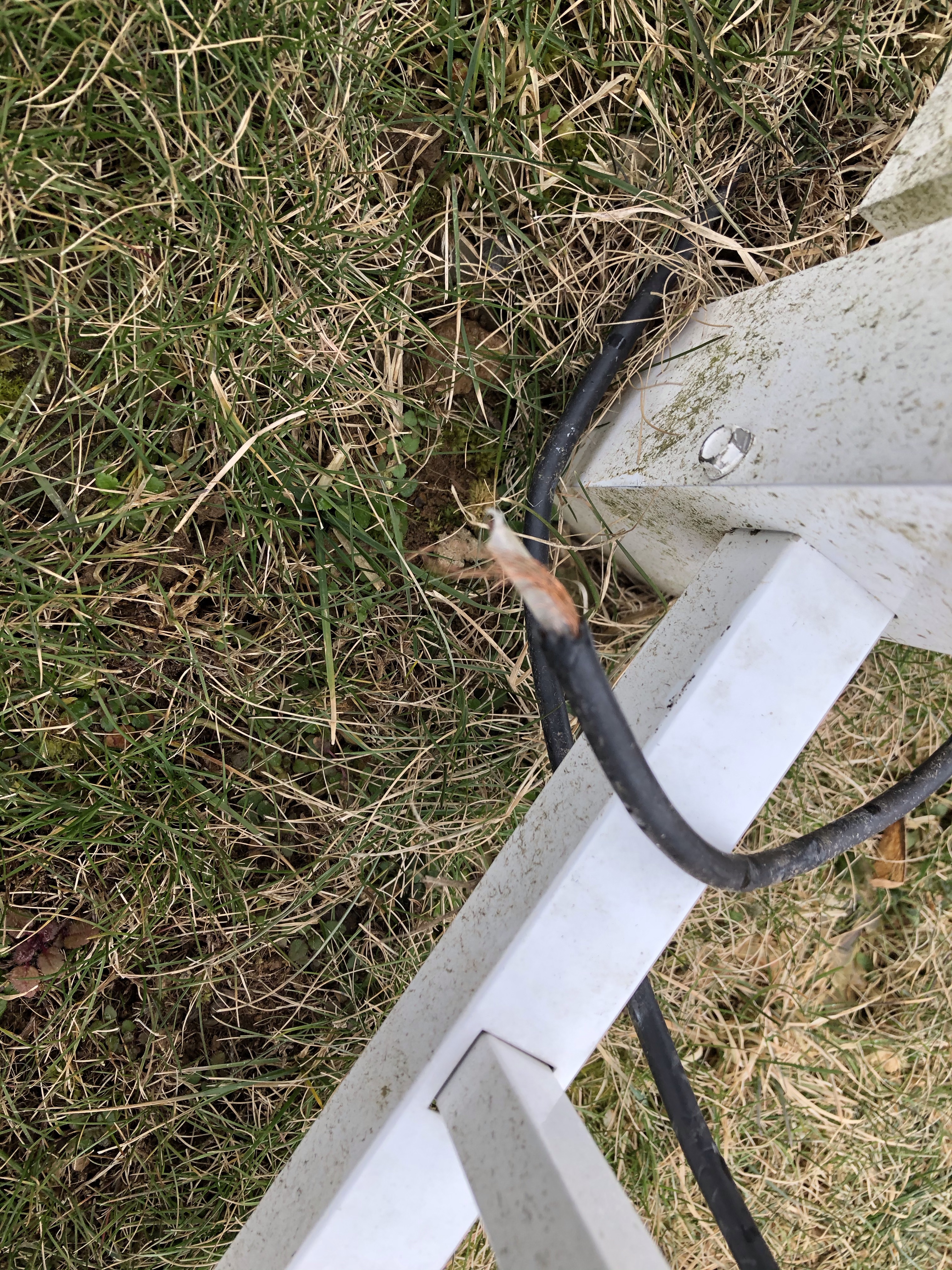
Being an amateur radio operator, I occasionally have to deal with equipment maintenance issues. I first noticed the problem when I found it difficult to communicate with several nearby VHF/UHF repeaters. Then, I noticed that my HF radio would not tune on 75 meters. I checked on all of my indoor cables and found no problems, so I ventured outside and noticed the following significant damage to my amateur radio antenna system.
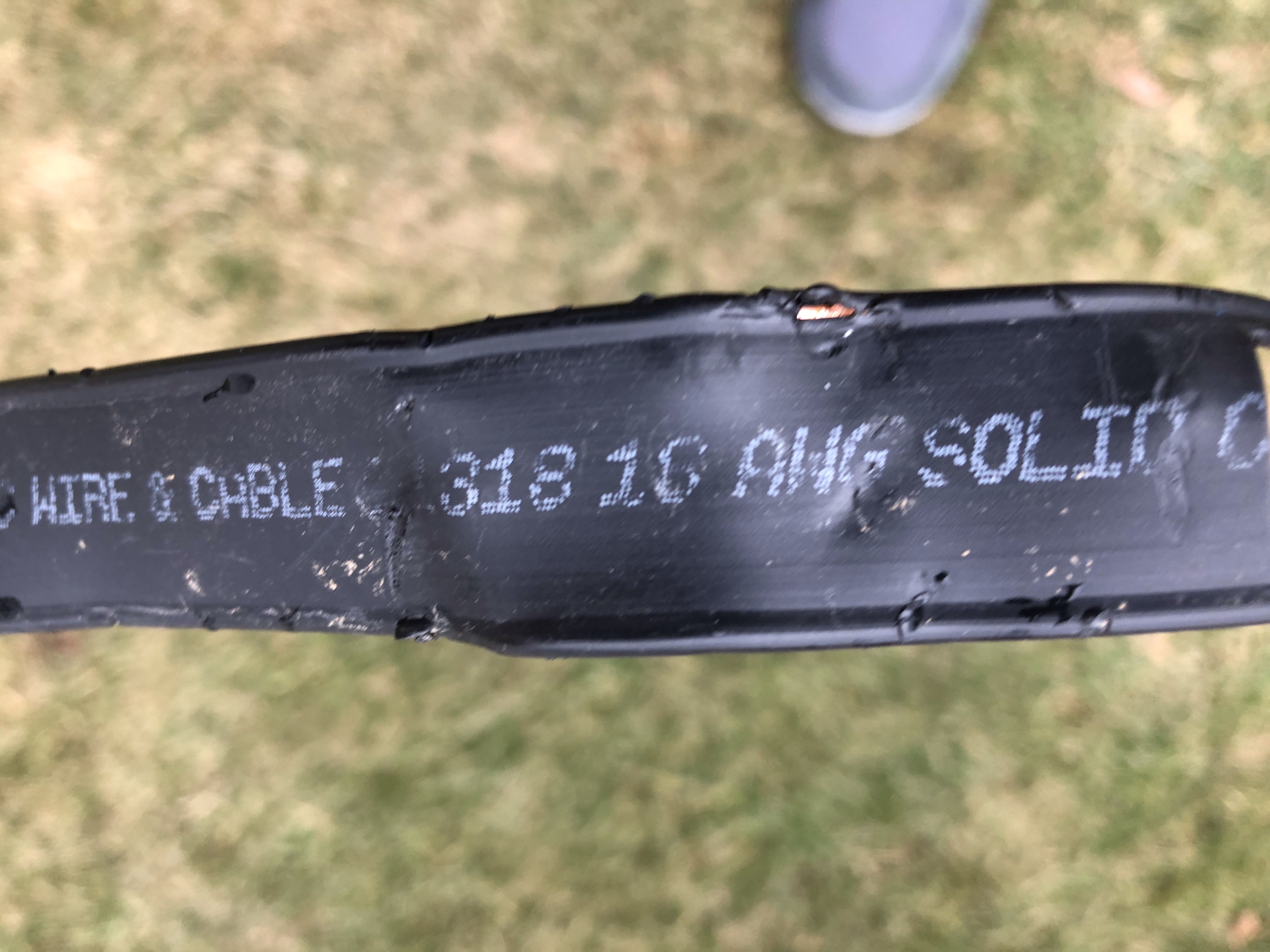
Apparently, an animal had chewed through my VHF/UHF feed line. My dogs didn’t do it because it was outside of the fence.
There was also damage to the HF ladder line feed to my G5RV antenna. There were many visible tooth marks. The coax around the balun was destroyed. These components we’re well outside of the fence.
I used an auxiliary feed as a temporary fix for my VHF/UHF Yagi. I needed to obtain a new G5RV antenna.
Update: 3/4/2020
I installed a new G5RV antenna today. I also cleaned the corrosion from my feed line connectors at the balun. I was able to tune up on 75 meters.



 Stormstown Dispatch