Gaston and Invest 99L

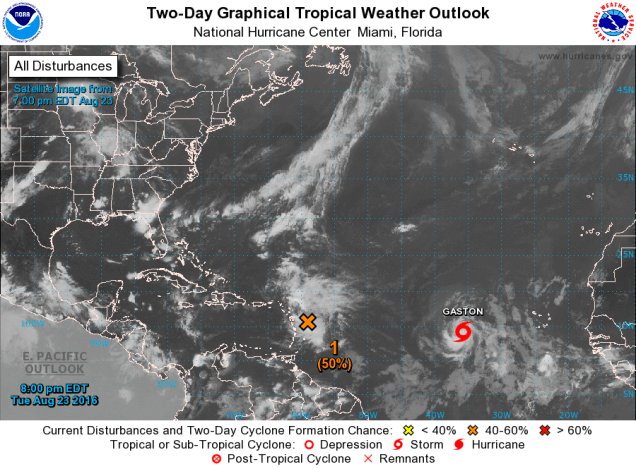
Tropical Storm Gaston developed today. However, unless you’re shipping something across the Atlantic, that’s all you need to know. It is forecast to recurve and remain at sea.

two_atl_2d0

The focus is still on Invest 99L. Now the ECMWF model is bullish on possible US landfall in The Gulf of Mexico around the Florida panhandle next Tuesday. The GFS model, not so much. Still too far out for any reasonable certainty.

storm_99

Invest 90 and 99

As stated in a previous post, the forecasts can significantly change for systems that are forecast many days in advance. The 06 UTC GFS model run is not so bullish on Invest 99. The GFS now shows the storm making a hard right out to sea as it moves near The Bahamas.

storm_99

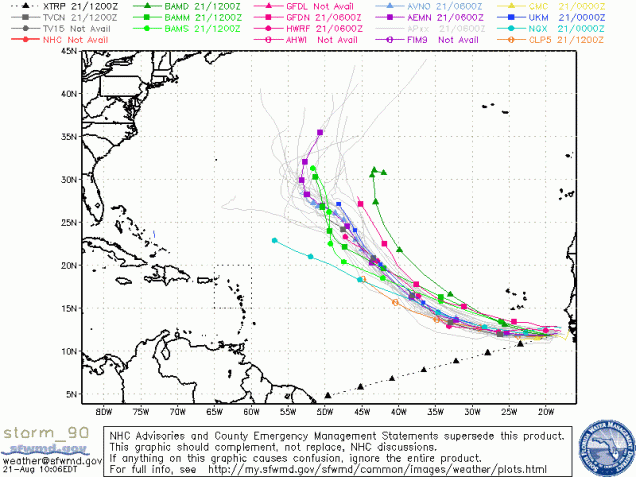
Focus is also on Invest 90 which is ow developing off the west coast of Africa. The models, as of this writing, indicate that it will not be a threat to the US.

storm_90

Proto Gaston

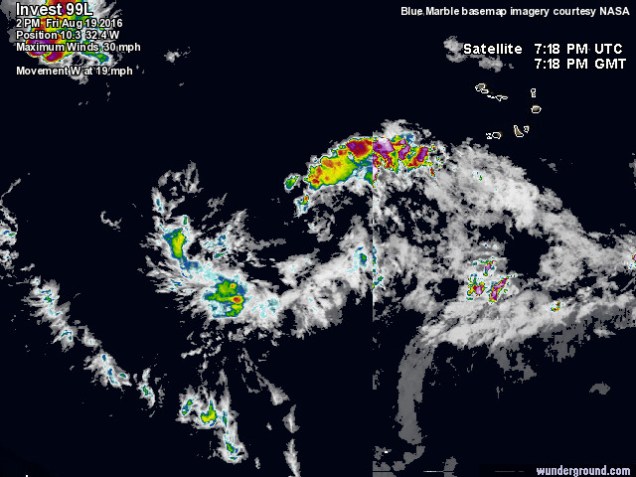
The following image looks innocuous, but it has the potential to develop into a major Atlantic tropical system within the next week or so.

99L

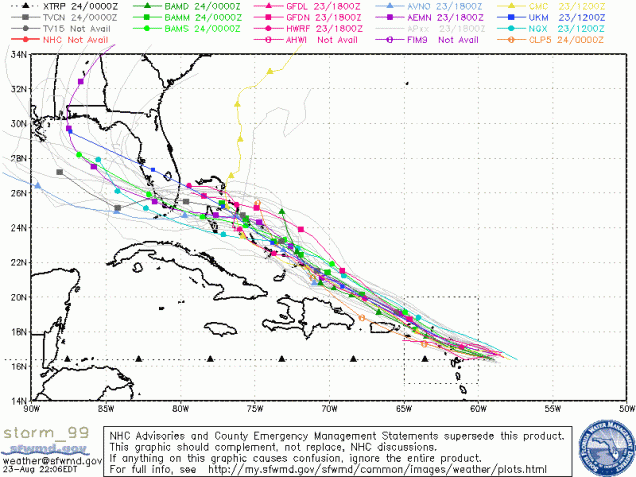
The models, as of this afternoon, have the storm tracking near Florida and/or into The Gulf of Mexico. However, this is still many days away and the forecast can change.

storm_99

The GFS model is especially bullish, as seen in the video below.

Climate Talking Points

  1. There is no 97% consensus of scientists. In a 2013 survey of the professional members of the American Meteorological Society, only 52% believed that global warming was primarily man-made – much less dangerous. No group in the survey came anywhere close to reaching 97%.
  2. Heatwaves are not getting worse. According to the EPA, the worst heatwaves in the US (by far) occurred during the 1930’s – when the Midwest commonly saw temperatures over 110 degrees, and as high as 120 degrees.
  3. Droughts are not getting worse. According to NOAA, the US has been getting steadily wetter over the past century.
  4. Scientists say that California has had much more severe droughts in the past, lasting as long as 200 years. The past 100 years was the wettest century on record in California.
  5. Hurricanes are not getting worse. The US is experiencing a record quiet period for hurricanes.
  6. According to the Danish Meteorological Institute, the Arctic Ocean is full of thick ice. There is more ice on the Russian side than there has been in years, and a group of global warming sailors are currently blocked by impenetrable ice in the Northeast Passage.
  7. Polar Bear populations are not decreasing. In fact, there are more Polar Bears now than when Al Gore was born.
  8. Sea level has been rising for 20,000 years, since the end of the last ice age. Most of that time much faster than now. It has nothing to do with humans.
  9. According to NOAA, sea level is only rising 1.7 to 1.8 mm/year. At that rate, it will take thousands of years for Manhattan to drown.
  10. According to NOAA, sea level at Manhattan has been rising at about the same rate (2.8 mm/year) since the 1850’s. There is no indication that humans are affecting the rate of sea level rise.
  11. Glaciers have been melting for a very long time. In 1879, John Muir (founder of the Sierra Club) found that Alaska’s largest glacier had retreated 48 miles since 1794. Twenty thousand years ago, Chicago was buried under a mile of glacial ice.
  12. Forest fires are not getting worse over the long term. According to USDA, the US had five times as much burn acreage in the 1930’s as we do now.
  13. Climate models have epically failed, and greatly over-predict warming.
  14. Our most accurate systems for measuring global temperature, satellites, show that this year (2022) is no warmer than 1998.
These points are unassailable, and backed by government data. So which side is fear mongering?

Stormstown: A Brief History

The village that is now called Stormstown was located on one of the area’s earliest roads. Laid out in 1791-92, the road served as a main route for the shipment of Centre County iron west to Pittsburgh. First settler Abraham Elder’s tavern, on the east end of the village, was a stopping place for iron haulers. In 1812 David Storm recorded a plat of 30 lots, plus a school lot, that he named Walkerville, on the west side of present-day Municipal Lane in the middle of Stormstown. The origin of the Walker connection has not yet been tracked down. Some twenty years after Walkerville was established, Caleb Way slowly started selling off lots between Walkerville and the former site of Elder’ tavern, in an area that was briefly called Wayville. Eventually, by the time of the Civil War, the whole area was called Stormstown. The enterprises of the village included a gristmill, sawmill, distillery, tannery, wagon maker, and several craftsmen’s shops – blacksmith, weaver, potter, and chairmaker.

On April 7, 1867, an Easter fire destroyed twenty-six buildings, many of which were never rebuilt. The fire started in George Matters house and in less than three hours, the entire portion of the town lying between the Port Matilda Road and Capt. Hunter’s residence, 2/3 of Stormstown was destroyed by fire. In addition to these losses, all the stables and outhouses on the south side of the street and east of the road to Pine Grove Mills were destroyed.
Climate Debate Rules

Rule 1 – Do not make the thoroughly discredited claim that 97% of scientists agree that humans are warming the globe significantly.

Rule 2 – Do not employ the use of an ad hominem, dismiss an argument solely based on its source or funding, or employ any other logical fallacies.

Rule 3 – Stay on topic. No strawman arguments.

Rule 4 – Answer questions.

Rule 5 – When you are wrong, admit it and apologize.

Rule 6 – There is no Rule 6

Revolutionary War Antecedent 

Found out today that my 5th great grandfather, on my mother’s side,  was an officer in The Continental Army:

Facebook Post

Very apropos today.

His obituary:

In Greenfield (New Hampshire) on  (July 13, 1815) inst. Col. WILLIAM
SCOTT, Esq. in the 71st year of his age. In his death the companion of his bosom lost an enduring partner, his children an affectionate parent, his neighbors a kind friend, the needy a benevolent benefactor, and the inhabitants of the U.S. a worthy and venerable patriot.  

Col. Scott emigrated to America about 11 years previous to the revolutionary war, in which he took an early, and an active part, for his country’s rights. He was in the battles of Bunker-Hill, Trenton, Monmouth, White Plains and Saratoga, and in almost every battle of note during the war.