July was 3.8 deg F above normal for temperature. The high for the month was 95.1 deg. F recorded on July 18. The low for the month was 54.7 deg F, recorded on July 14. There were 12 days at or above 90 deg F. There were 13 heating degree days and 334 cooling degree days.
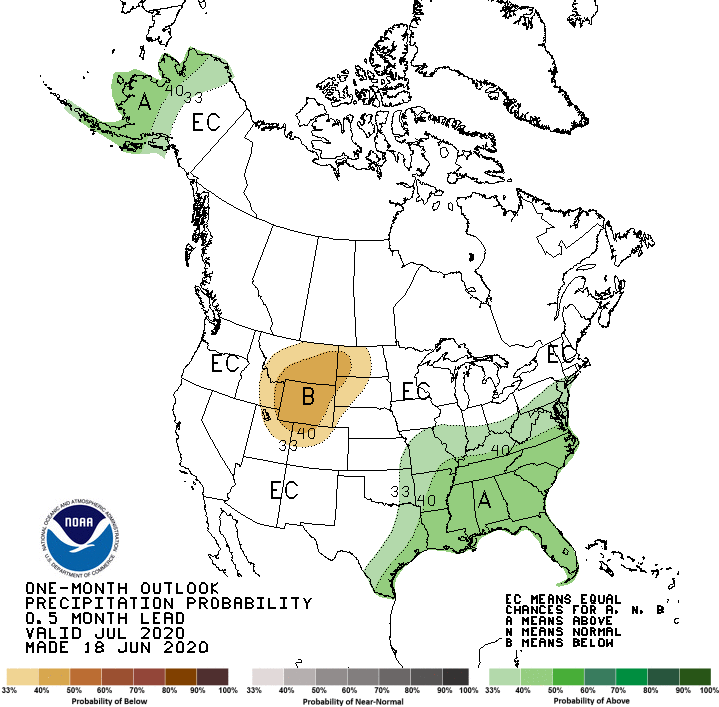
July was a below normal month for precipitation with 1.19 inches of rainfall recorded, which was 2.27 inches below normal. The maximum rainfall in a single day was 0.33 inches recorded on July 31. There were 9 days of rain >.01 in, 4 >.10 in and 0 >1 in.
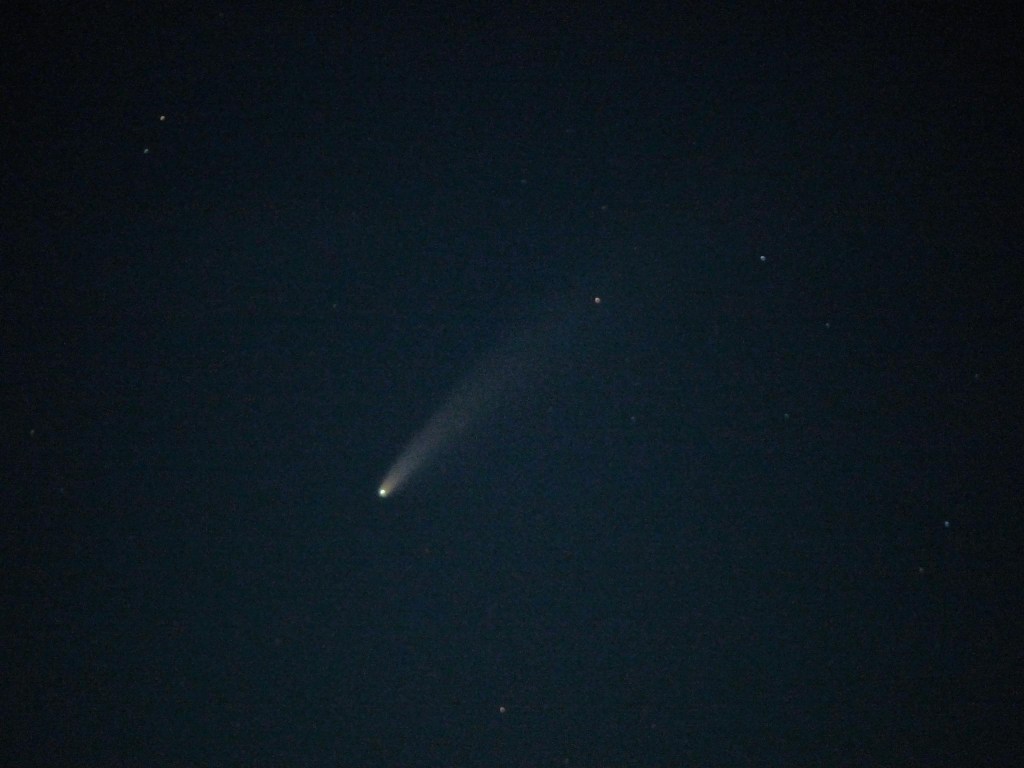
On July 13, 2020, I assembled my equipment to see if I could get images of Comet NEOWISE (C/2020 F3). I used my sturdiest tripod, remote shutter release, DSLR camera and binoculars. I set up on my deck, behind our house, which faces to the northwest. At about 8:45 PM EDT, I started by observation session.
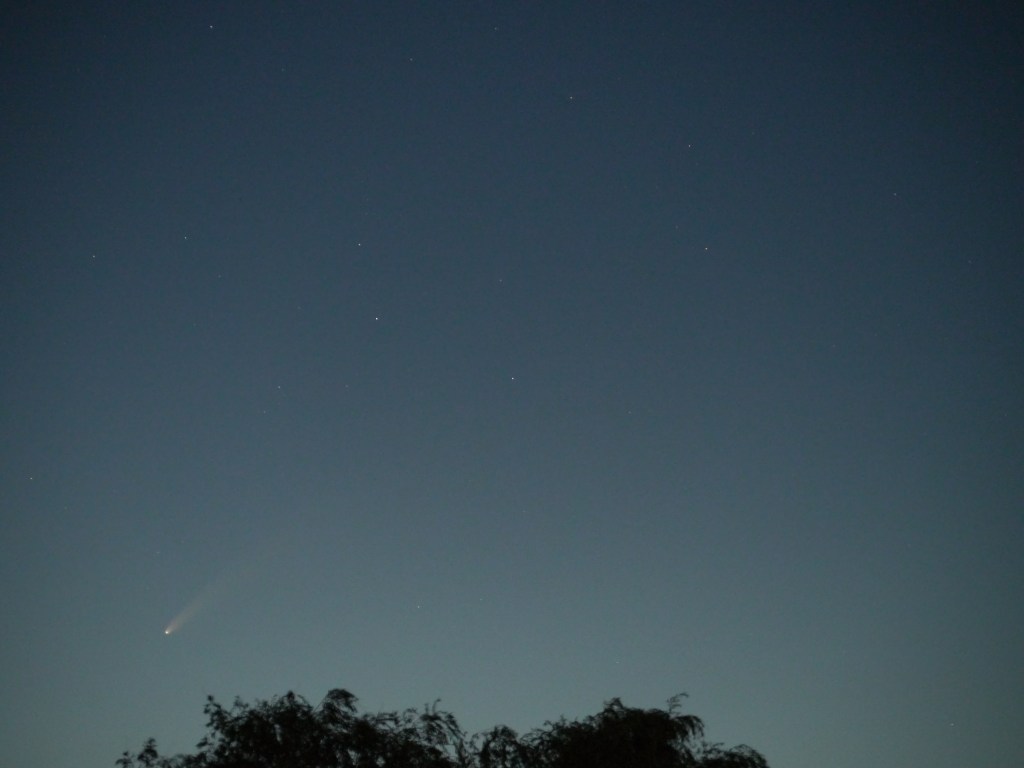
Conditions were a little less than ideal. The sky along the horizon looked hazy and it was still twilight. The stars were not visible, which made it hard to find the comet without any points of reference. I scanned the skies with my binoculars to try to find it. Around 9:45 PM EDT, I thought it was a bust and began to break the equipment down for the night. I thought that it had already set behind Bald Eagle Ridge. However, I decided to scan the sky one last time. That’s when I spotted NEOWISE with my binoculars. I quickly set up again, pointed the camera in the general area, at 100 mm focal length, and got the following image.
2 sec exposure, f/4.7, ISO 1600, Focal Length 103
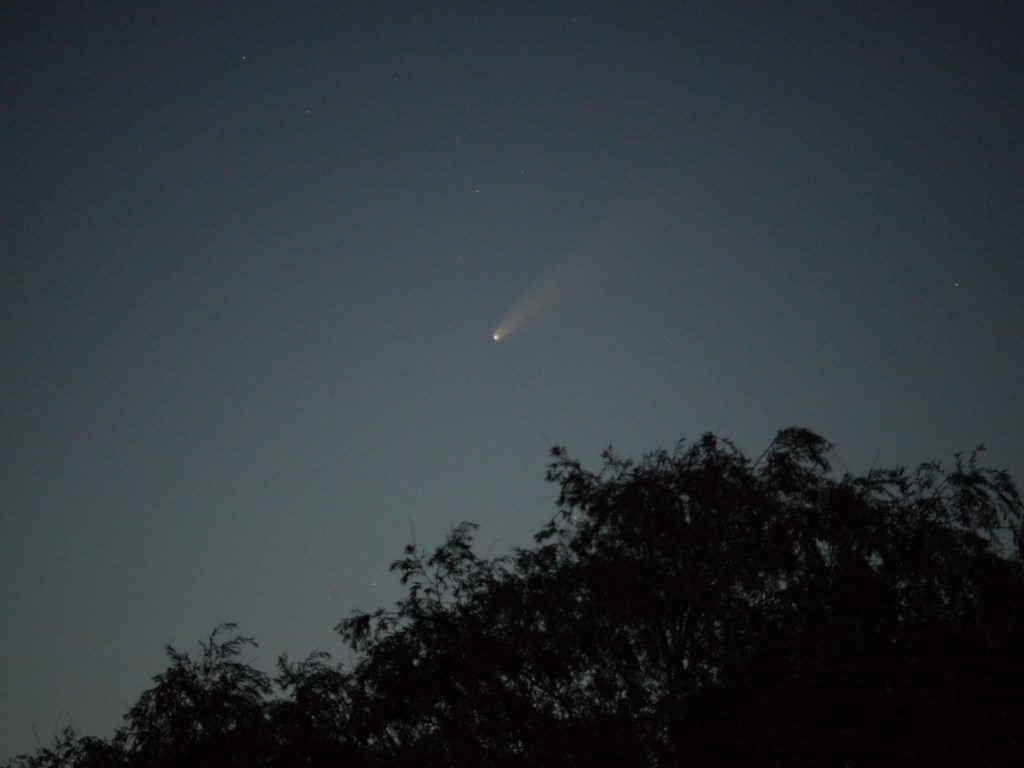
I centered the image in the viewfinder, zoomed in to 200 mm focal length, and took several more images before the comet faded in the haze and set behind the tree. The following images were the two best results.
2 sec exposure, f/5.6, ISO 1600, Focal Length 2002 sec exposure, f/5.6, ISO 1600, Focal Length 200
The following night, I was able to take this image.
Comet C/2020 F3 NEOWISE (Neowise, for short) is the third comet this year to be discovered by astronomers. It may become a bright, naked eye object, beginning July 11, if it survives its closest approach to The Sun. Some comets either breakup or fall into The Sun at perihelion.
Neowise has already made an appearance in the early morning hours, and some have taken photographs.
Neowise over Toronto
The comet will make its closest approach to Earth on July 23, which may make for a spectacular viewing opportunity if it holds together. Neowise will also be a bit higher in the sky on July 24 and 25.
There hasn’t been a bright comet since Hale-Bopp in 1997. However, comets are notoriously unpredictable, and this one could break up and burn out at any time.
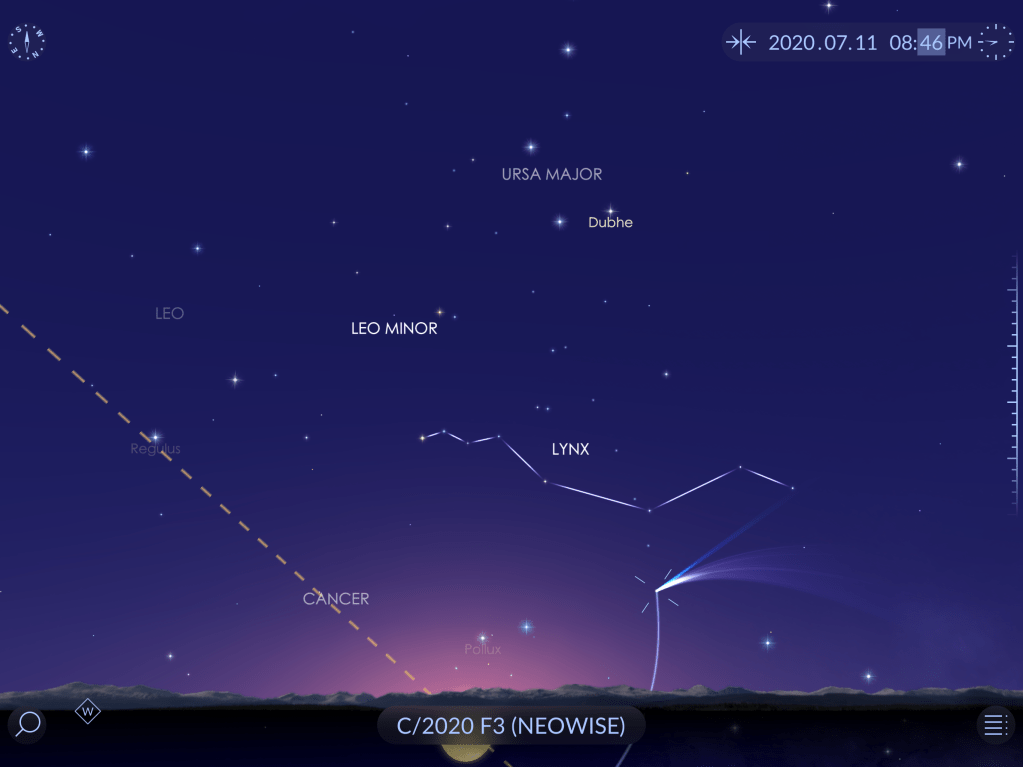
Here’s where you can spot the comet beginning Sunday, July 11. Online resources like TheSkyLive also offer similar night sky maps.
June was 0.1 deg F above normal for temperature. The high for the month was 88 deg. F recorded on June 9. The low for the month was 41 deg F, recorded on June 1. There were 71 heating degree days and 168 cooling degree days.
June was an above normal month for precipitation with 4.80 inches of rainfall recorded, which was 0.94 inches above normal. The maximum rainfall in a single day was 1.56 inches recorded on June 4. There were 8 days of rain >.01 in, 7 >.10 in and 1 >1 in.
The American Radio Relay League (ARRL) Field Day is the most popular on-the-air event held each year, on the fourth weekend in June, in The United States and Canada. More than 40000 radio amateurs gather to operate from remote locations. It is a time where many aspects of amateur radio come together to highlight its many roles. It is an excellent opportunity to demonstrate its emergency capabilities to organizations and the general public. Despite the development of modern communications systems, they can fail. When they do, amateur radio can provide communications support during emergencies and post-disaster situations.
This year was different due to the COVID-19 restrictions. Instead of gathering and setting up at public locations, amateur radio operators (hams) were encouraged to operate from home. In addition, one rule was waived to allow those operating on commercial power to contact other stations that were also operating on commercial power. All other rules applied. Some hams operated on power provided by batteries, generators, solar panels, or other means not using commercial power.
Hams across North America communicated using voice, morse code (carrier wave or CW), and many digital modes. They operated to make as many contacts as possible from 2 PM EDT on Saturday until 2 PM EDT on Sunday. According to the rules, those that waited until 2 PM Saturday to set up their stations were permitted to operate until 8 PM on Sunday.
As for myself, I made 28 contacts on the 20 and 40-meter bands using the digital phase shift keying 31 baud mode (PSK31). Each contact sent digitally is worth 2 points each. Since I used only 50 watts of power, I qualified for a multiplier of 2, so my score was 112 points. I also sent 10 formal radiograms (100 points), including one to the ARRL Western Pennsylvania Section Manager (another 100 points). Finally, I submitted my Field Day entry electronically (another 50 points). My preliminary total was 462 points. I made contacts in Alabama, Florida, Illinois, Indiana, Iowa, Maine, Massachusetts, Michigan, Minnesota, Missouri, New Jersey, New York, North Carolina, Pennsylvania, Tennessee, Wisconsin, and Ontario.
May was 1.8 deg F below normal for temperature. The high for the month was 86 F, recorded on May 26. The low for the month was 27.2 deg F, recorded on May 9. There were 3 days at or below 32 F. There were 291 heating degree days and 54 cooling degree days.
May was a below-normal month for precipitation with 1.72 inches of rainfall recorded, which was 1.51 inches below normal. The maximum rainfall in a single day was 0.43 inches recorded on May 6. There were 11 days of rain >.01 in, 4 >.10 in and 0 > 1 in.
April was 3.1 deg F below normal for temperature. The high for the month was 69.8 F, recorded on April 8. The low for the month was 24.2 deg F, recorded on April 17. There were 7 days at or below 32 F. There were 557 heating degree days and 1 cooling degree day.
April was an above-normal month for precipitation with 5.06 inches of rainfall recorded, which was 1.67 inches above normal. The maximum rainfall in a single day was 1.34 inches recorded on April 30. There were 15 days of rain >.01 in, 10 >.10 in and 1 > 1 in.
It snowed two inches on April 18, which had all but melted by the end of the following day.
High wind speed of 42 mph on April 10.
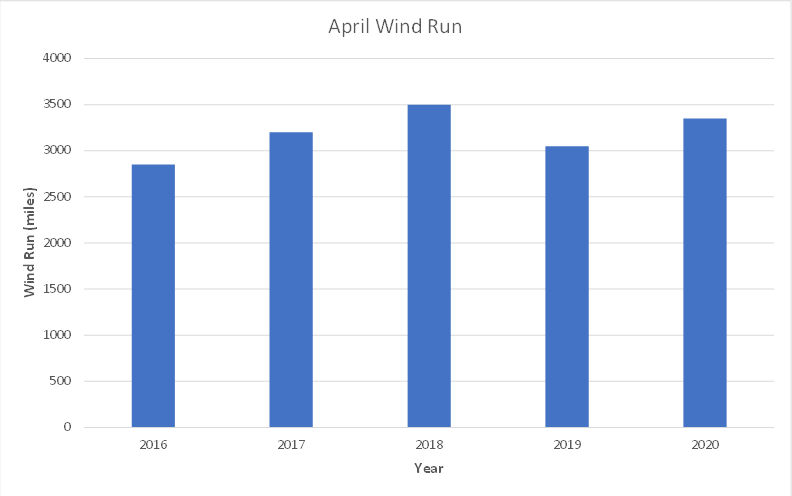
One kind reader remarked that this April seemed to be windier than usual. Here are the wind data for April during the past 5 years (2016-2020):
Year
Wind Run (mi)
Avg (mph)
High (mph)
2016
2850
4.0
43
2017
3200
4.4
38
2018
3500
4.8
53
2019
3050
4.2
45
2020
3350
4.7
42
Wind run is the total distance of the traveled wind over a period of time.
By any measure, April 2018 was the windiest during the past 5 years.
Today was the 2020 Spring Simulated Emergency Test (SET) amateur radio network in western Pennsylvania. The SET is a training exercise involving the Amateur Radio Emergency Service (ARES) and the National Traffic System (NTS), a message-handling service of amateur radio. Its primary purposes are to evaluate strengths and weaknesses in emergency preparedness and communications and to demonstrate amateur radio to the public.
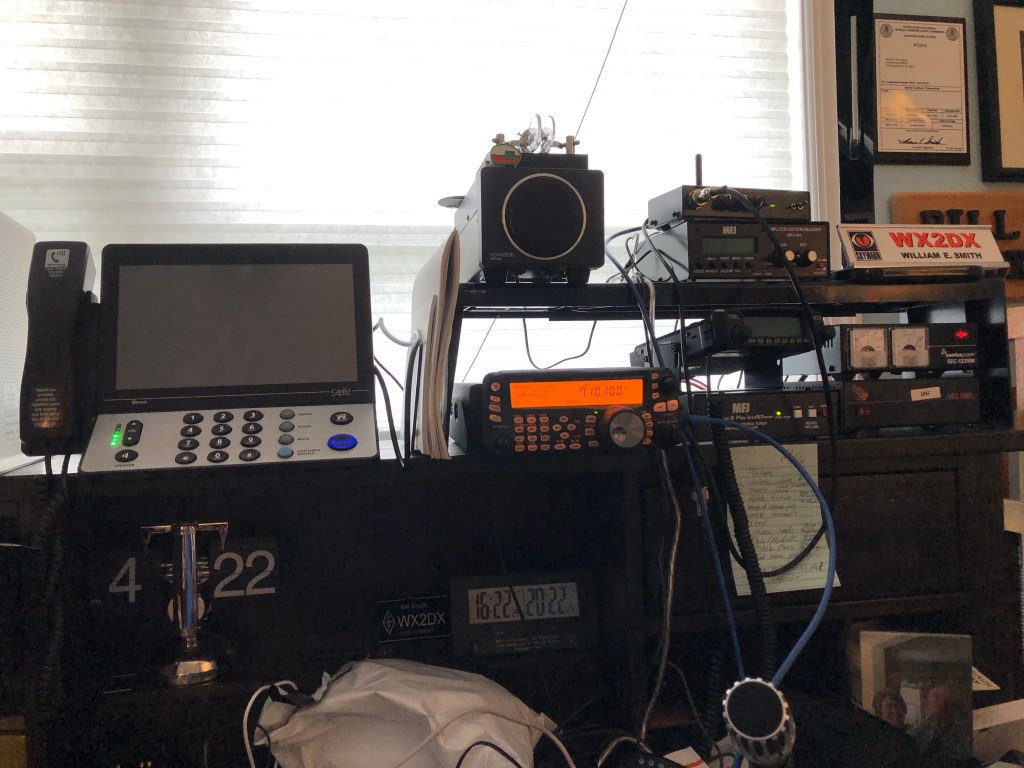
My simulated position was at The Grays Woods Elementary School Emergency Shelter. However, I was actually operating from my home VHF/UHF and HF base stations. We were all sheltering in place due to the COVID-19 pandemic. I was mainly operating on 75 meters using the Olivia digital mode.
We were sending formal formatted messages to net control. I sent three pieces of traffic containing shelter status. However, it got a bit silly at the end of the exercise. There was a message announcing the touch down of a tornado west of Pine Grove Mills in The PSU Ag fields. Then there was a voice message concerning a hungry elephant found in a closet at Juniper Village.
March was 6.6 deg F above normal for temperature. The high for the month was 72.5 deg. F, recorded on March 20. The low for the month was 22.1 deg F, recorded on March 1. There were 10 days at or below 32 F. There were 657 heating degree days and 0 cooling degree days.
March was an above-normal month for precipitation with 5.26 inches of rainfall recorded, which was 1.71 inches above normal. The maximum rainfall in a single day was 1.78 inches recorded on March 28. There were 19 days of rain >.01 in, 9 >.10 in and 1 > 1 in.






 By any measure, April 2018 was the windiest during the past 5 years.


 Stormstown Dispatch