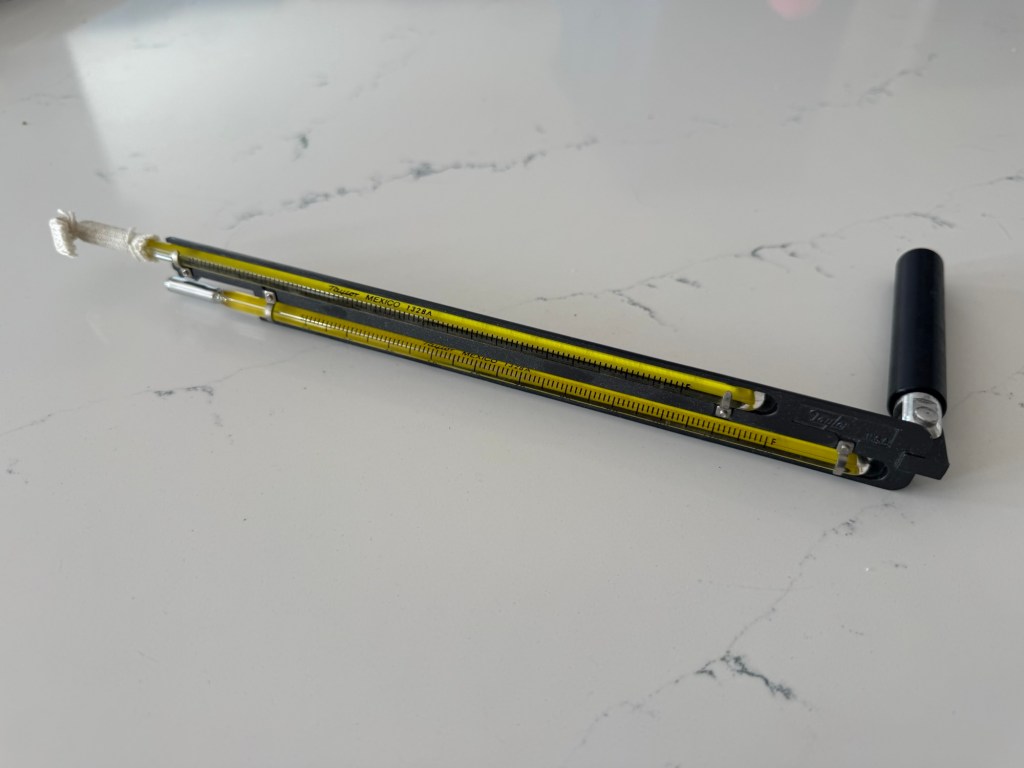
Before electronic hygrometers became widely available, one of the primary instruments used to measure atmospheric humidity was the sling psychrometer.
James Hutton was the first to discover that a thermometer moistened by water will show a cooler temperature than a dry thermometer when exposed to the wind. Psychrometric equations were later developed and refined during the 19th Century.
The sling psychometer consists of two thermometers mounted side by side on a frame. One thermometer is kept dry and measures the ambient air temperature; this is known as the dry-bulb thermometer. The other thermometer has its bulb wrapped in a cotton wick that is saturated with distilled water. This is the wet-bulb thermometer.
The frame is attached to a handle with a swivel joint, allowing the thermometers to be rapidly swung through the air. As air passes over the wet wick, evaporation occurs, causing the temperature of the wet-bulb thermometer to decrease. The amount of cooling depends on the moisture content of the air. Drier air promotes more evaporation and produces a larger temperature difference between the wet-bulb and dry-bulb readings, while humid air results in less cooling.
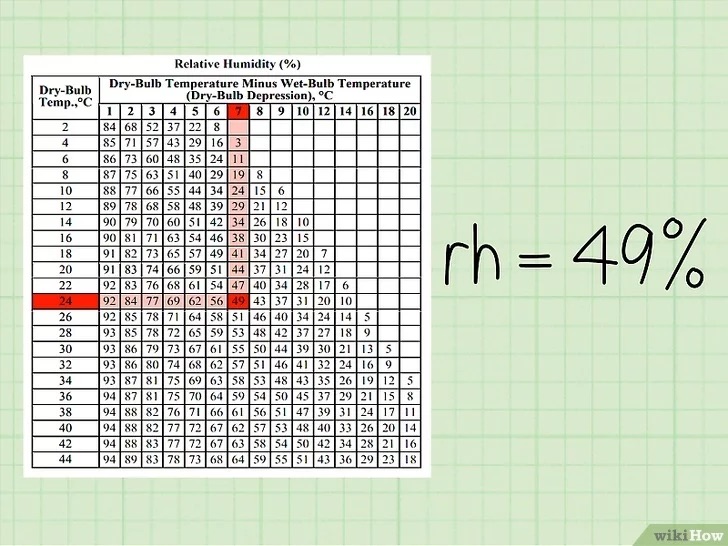
After the instrument has been spun for a sufficient period, the wet-bulb and dry-bulb temperatures are quickly recorded. Using psychrometric tables or charts, these readings can then be used to determine the relative humidity, absolute humidity, or dew point temperature.
Although modern electronic sensors have largely replaced sling psychrometers, the instrument remains an important teaching tool and a reliable reference standard for humidity measurements.


Thanks for sending this! I’m convinced that with all of the tools that you have, you probably have created a type of “fountain of youth,” which is why you still look like you’re 20 years old after 50 years have zoomed by.
Have a great day! ☀️ Marcia
LikeLike